When you invest in industrial automation, you’re entering a relationship that often lasts decades. PASCO® has spent nearly 50 years building end-of-line systems that hold up in real production environments not just during commissioning, but shift after shift, year after year. Our reputation isn’t built on promises. It’s built on systems that stay running and support that shows up when it matters.
How PASCO® approaches automation
Designed and built in-house
While most automation providers outsource key components, PASCO® is a true end-to-end manufacturer. Every structure, control panel, and electrical enclosure is designed and built in our St. Louis facility. That gives us unmatched control over quality, timing, and support. Need a part overnight? We likely have it on the shelf, or we’ll fabricate it in-house. We don’t often wait on vendors, and neither should you.
Factory-certified service from the people who built the system
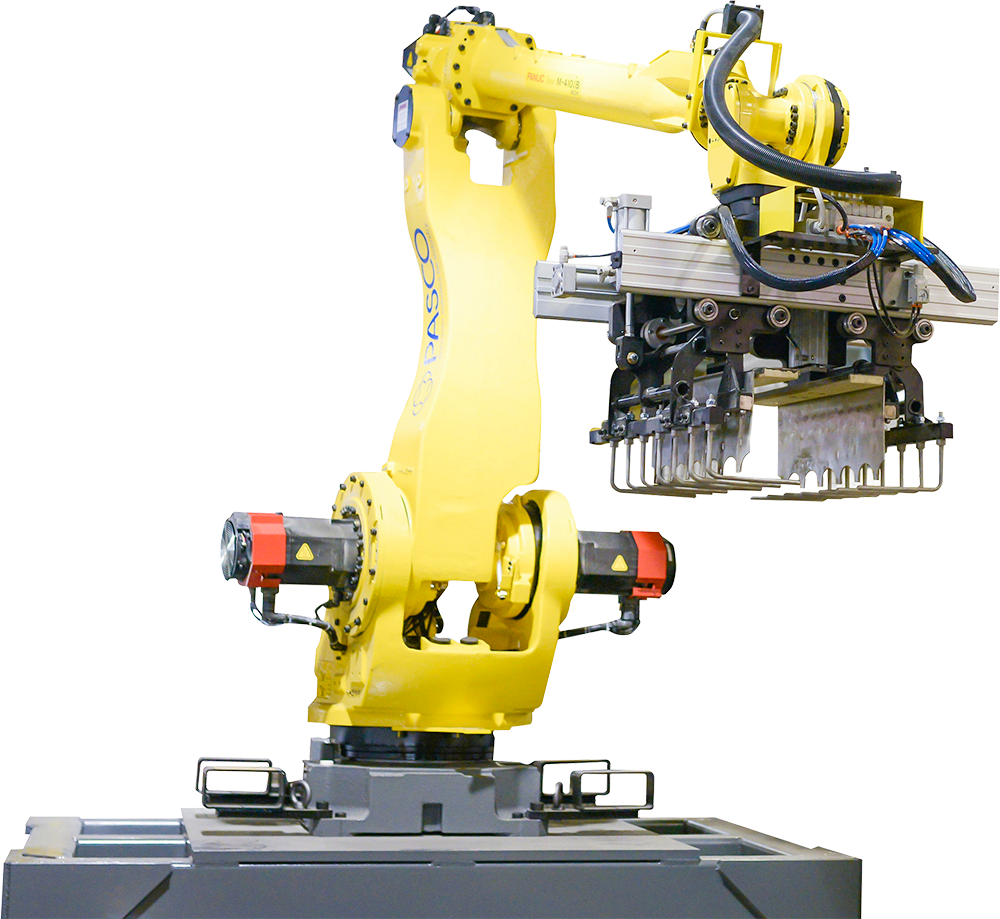
We’re one of fewer than 20 FANUC Certified Servicing Integrators in the country. That certification means your system can be supported by a single technician on a single visit. No finger-pointing, outsourcing or passing the buck. Our technicians know the equipment because we built it.
No proprietary lock-in
PASCO® systems are designed for transparency and accessibility. We provide original part numbers for every motor, sensor, and actuator so you’re never forced to come back to us for replacements. If it’s available locally, you’re free to source it yourself. Our goal remains keeping you running, not creating dependency on proprietary parts.
Built for real plants
Forklifts will hit your equipment. Dust and debris accumulate everywhere. Operators push systems to their limits every shift. PASCO® systems are fabricated from structural steel channel specifically to handle this abuse. We design for industrial reality so durability becomes the baseline, not an add-on feature.
Diagnostics that support better decisions
Our systems feature I/O Link-enabled diagnostics, giving operators and maintenance teams access to real-time performance data, historical trends, and deeper visibility into every shift. From stack pattern control to speed tuning, your team gets the tools to optimize production.
A warranty we stand behind
We back what we build with a comprehensive one-year warranty that covers the full system, including robots. When you need support, you get it from people who understand every component because they manufactured it.
Designed to grow with your operation
Whether you’re outfitting a single line or scaling across a network of facilities, PASCO® systems are designed with the future in mind. Modular layouts, proven controls architecture, and upgrade-ready platforms make it easy to grow without starting from scratch. Your automation becomes infrastructure that supports long-term growth.
Nearly 50 years of experience
PASCO® has been solving complex end-of-line challenges since 1976. We’ve seen trends come and go, but our commitment to building rugged systems and showing up for our customers has never wavered. We’re also a Certified Woman-Owned Business Enterprise (WBE). Every detail matters to us, from engineering to execution.
The bottom line
Plenty of companies can build a palletizing cell. Fewer take full ownership of the system and the relationship behind it. PASCO® builds equipment that lasts and backs it with people who pick up the phone and stay involved for the life of the system.
If you want a partner who takes ownership, picks up the phone, and builds systems that work as hard as you do, choose PASCO®.
What are the common applications of industrial automation?
Common applications of industrial automation include packaging, palletizing, material handling, quality control, and assembly processes, helping manufacturers improve efficiency, consistency, and safety in their production workflows.
What are the benefits of automated palletizing systems?
Automated palletizing systems offer increased efficiency, accuracy, and consistency in packaging processes, enabling businesses to streamline operations, reduce labor costs, and enhance product quality.
How does automated equipment enhance product quality?
Automated equipment enhances product quality by ensuring consistent manufacturing processes, reducing human error, and enabling real-time quality control monitoring to identify and rectify issues promptly.
What is the initial investment for automated equipment?
The initial investment for automated equipment can vary depending on the complexity of the system, the features required, and the scale of the operation. Automated equipment can require significant upfront costs, but the long-term benefits of increased efficiency and reduced labor costs can often justify the investment.
How does industrial automation improve worker safety?
Industrial automation reduces worker exposure to hazardous tasks, minimizing safety risks and improving overall workplace safety by automating dangerous processes and reducing the need for human intervention.
What types of industries use automated equipment most?
Industries that rely heavily on automated equipment include manufacturing, packaging, warehousing, and logistics, where automated systems improve efficiency, productivity, and consistency in repetitive tasks.
What is the primary goal of industrial automation in manufacturing?
The primary goal of industrial automation in manufacturing is to improve efficiency, productivity, and consistency in the production process.
What are the benefits of using automated equipment in manufacturing?
The benefits of using automated equipment in manufacturing include increased efficiency, improved product quality, reduced labor costs, and enhanced safety in harsh industrial environments.
Can automated equipment be integrated with existing systems?
Yes, automated equipment can typically be integrated with existing systems. PASCO's automation solutions are designed for seamless integration, allowing clients to enhance their existing operations with advanced packaging and processing capabilities.
What is the role of robotics in industrial automation?
Robotics plays a crucial role in industrial automation by enhancing precision, speed, and efficiency in manufacturing processes, enabling businesses to optimize production, reduce errors, and increase overall productivity.
What types of products are commonly palletized?
Common products palletized are items such as packaged goods, boxes, crates, drums, and other bulk materials that can be stacked efficiently for storage and transportation.
How does industrial automation reduce production costs?
Industrial automation reduces production costs by improving efficiency, reducing labor expenses, and increasing output consistency and quality, leading to lower overall operational costs.
Can industrial automation replace human workers completely?
Industrial automation can enhance productivity and efficiency, but completely replacing human workers may not be feasible or desirable in many industries due to the need for specialized skills, flexibility, and human judgment.
pasco systems, pasco, pasco equipment, productive automated systems corporation, automation equipment, process automation solutions, pasco library hours, pasco flights, pasco to lax, paco systems, modular palletizing automation systems, modular palletizing systems, palletizing system integrator