At the end of a production line, manual packaging is often where things slow down. Products come off the line faster than workers can inspect, pack, seal, label, and palletize them. When that bottleneck holds, the rest of the line holds with it. End-of-line automation fixes that.
The goal has also shifted over time. Early on, manufacturers measured success by how many labor positions automation replaced. Today, the focus is on consistent production flow – running at the same rate in hour eight as in hour one. Throughput, recovery from minor stops, and steady cycle times matter more than they used to.
Defining end of line automation
End-of-line automation, also known as packaging automation, refers to the technologies and systems used at the final stage of manufacturing before freight.
It covers every step between finished product and outbound shipping – inspection, packing, sealing, labeling, and palletizing. The goal is consistent throughput and fewer errors at the stage where manual handling tends to break down.
Why manufacturers automate the end of the line
Manufacturers who automate their end-of-line operations typically see improvements in three areas:
- Throughput: A manual crew might palletize 15 bags per minute for the first hour, then drop to 8 as fatigue sets in. An automated system runs at the same rate all shift, every shift. Throughput gains of up to 50% from palletizing automation alone are common.
- Labor costs: Direct labor savings typically run 40-50%, with most systems paying back in 12-24 months depending on volume and shift structure.
- Product damage: Consistent automated handling means more stable loads and fewer errors. Damage rates drop 20-30% on average, with payback in 12-18 months.
These are the numbers most manufacturers use to build the business case. But standard ROI models miss 50-60% of the real benefit. Injury costs, insurance, upstream idle time, warehouse rework, and overtime don’t always make it into the spreadsheet. And they should.
How automation improves throughput
Automated systems don’t slow down between shifts. They handle products the same way on cycle 10,000 as they did on cycle one.
There’s also an upstream effect that’s easy to underestimate. When the end of the line runs at its designed rate, the equipment upstream can finally run at its designed rate too. End-of-line bottlenecks cause upstream machines to idle and warehouse teams to scramble for rework. Fix the end of the line and you often unlock capacity across the whole operation.
Enhancing End-of-Line Efficiency with Automated & Robotic Logistics
The research findings demonstrate that the integration of automated and robotic logistics technologies, guided by TOC principles, can significantly enhance End-of-Line efficiency. TOC proved to be invaluable in identifying and addressing critical constraints within the material flow, enabling the optimisation of throughput and the minimisation of delays. Practical Implementation: The findings of this study have direct practical implications for manufacturing organisations seeking to improve the efficiency and agility of their End-of-Line operations. By implementing automated and robotic solutions, guided by TOC principles, businesses can achieve significant reductions in lead times, labour costs, and overall production costs.
Achieving End-of-Line Efficiency Through Automated and Robotic Logistics: A Simulation-Driven Approach, A Lewandowska-Ciszek, 2025
Sustainability advantages of automated packaging
Automated packaging systems support more sustainable operations in a few ways:
- Less material waste: Consistent pack patterns mean fewer damaged products and less excess packaging.
- Lower energy use: Automated systems typically use less energy than the manual processes they replace, especially when lighting, HVAC, and other support systems can be scaled back.
- Better resource use: Higher output per shift means manufacturers can meet demand without adding proportional energy or floor space.
As customers and regulators push harder for documented environmental performance, these gains are becoming part of the business case alongside the financial ones.
Core technologies in end-of-line automation
End-of-line automation systems bring together several types of equipment working in coordination:
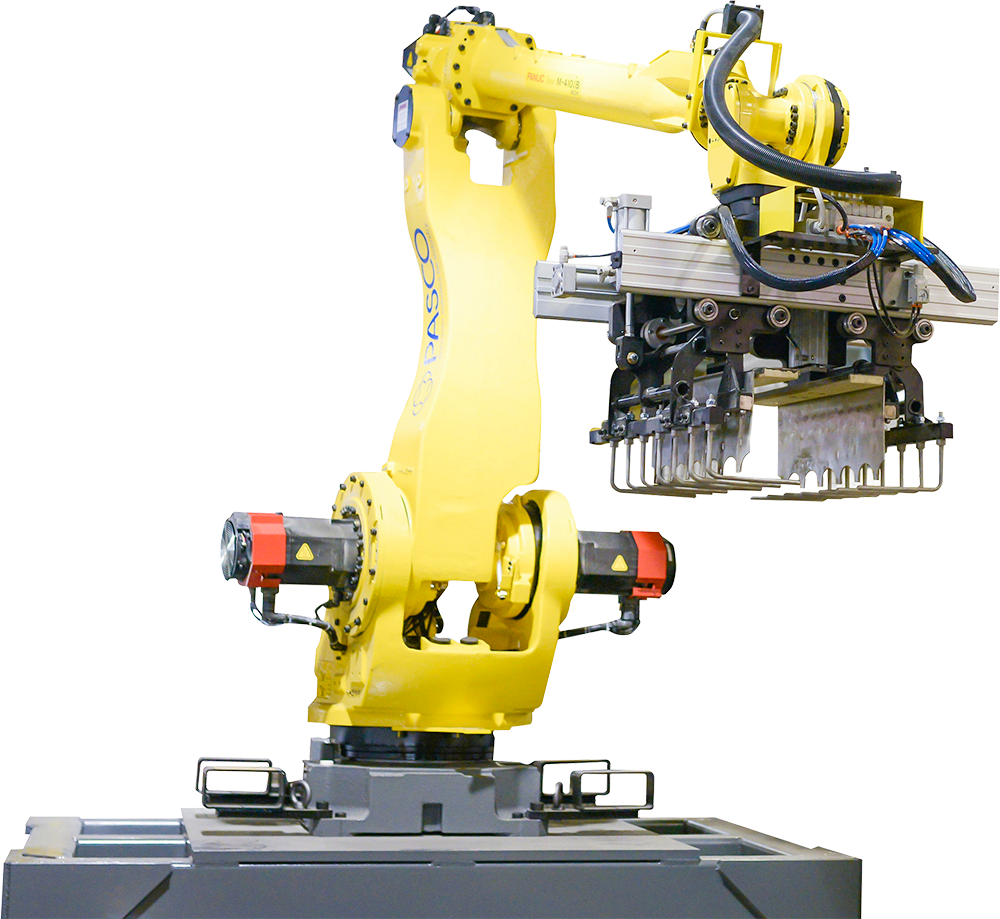
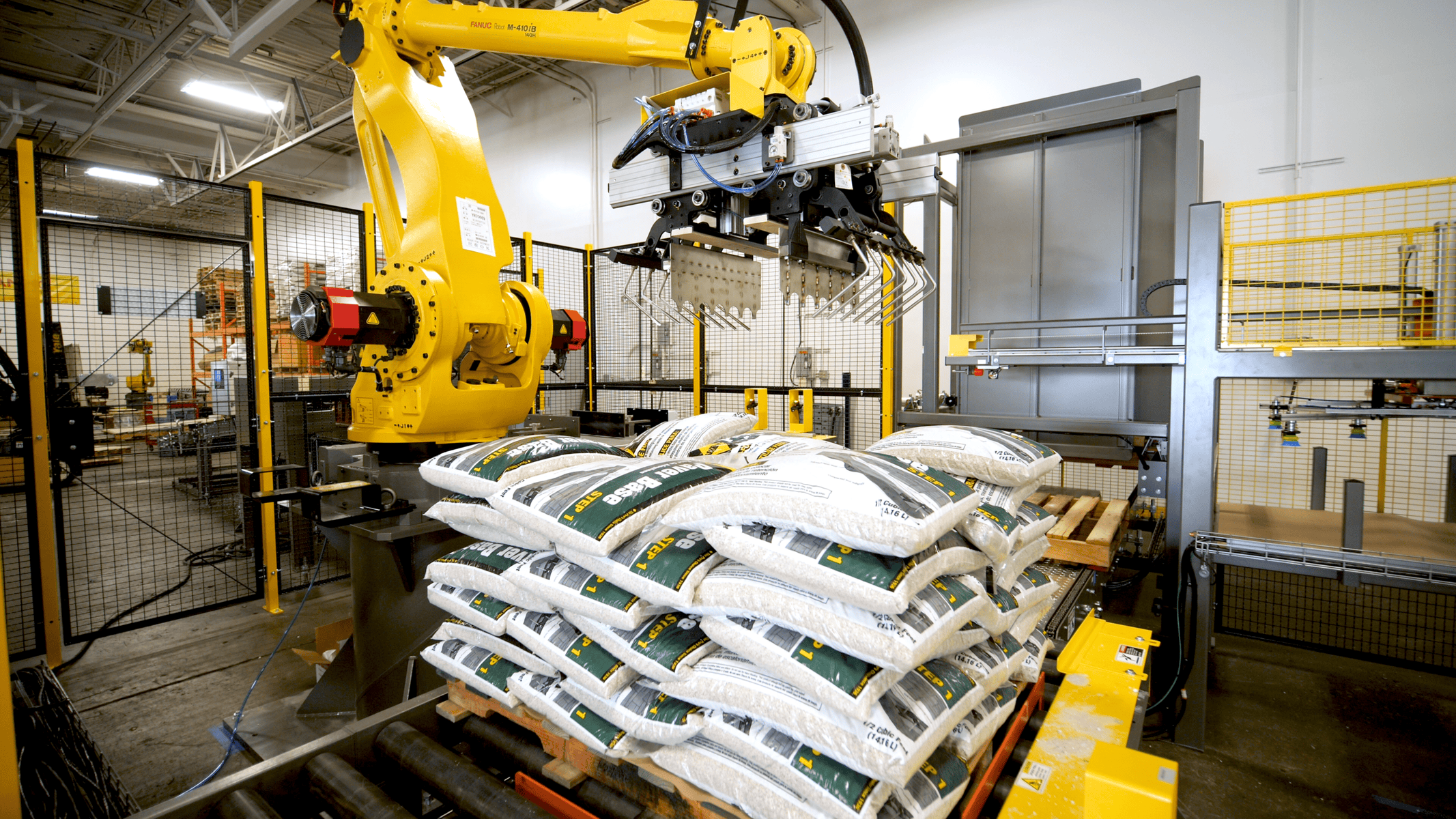
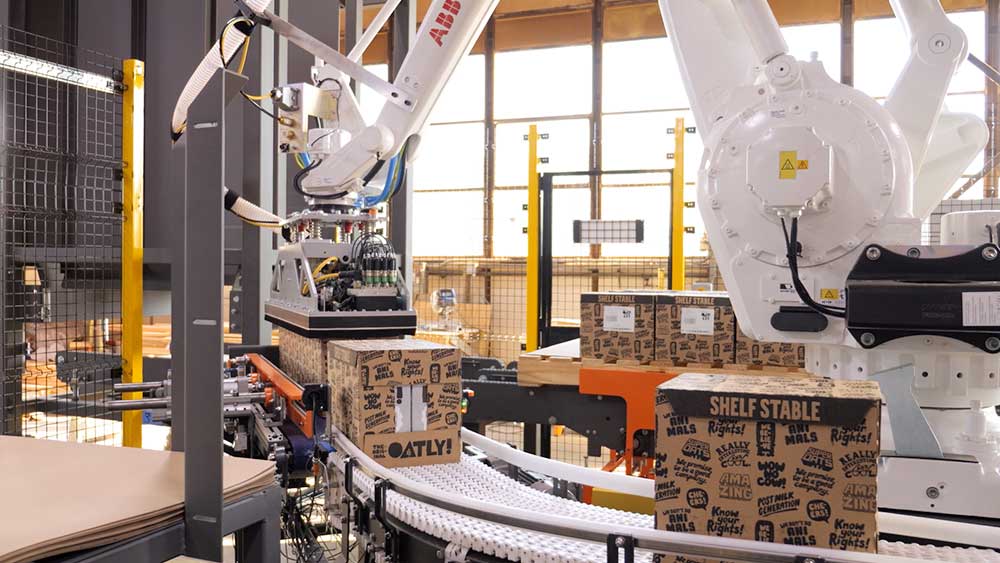
- Robots: Robotic arms handle palletizing, packing, bag placing, depalletizing, and other repetitive tasks at speeds and consistency levels manual labor can’t sustain across a full shift.
- End-of-arm tooling: The tooling attached to a robot determines what it can pick, place, and handle. It’s engineered to the specific product and to the environment it operates in.
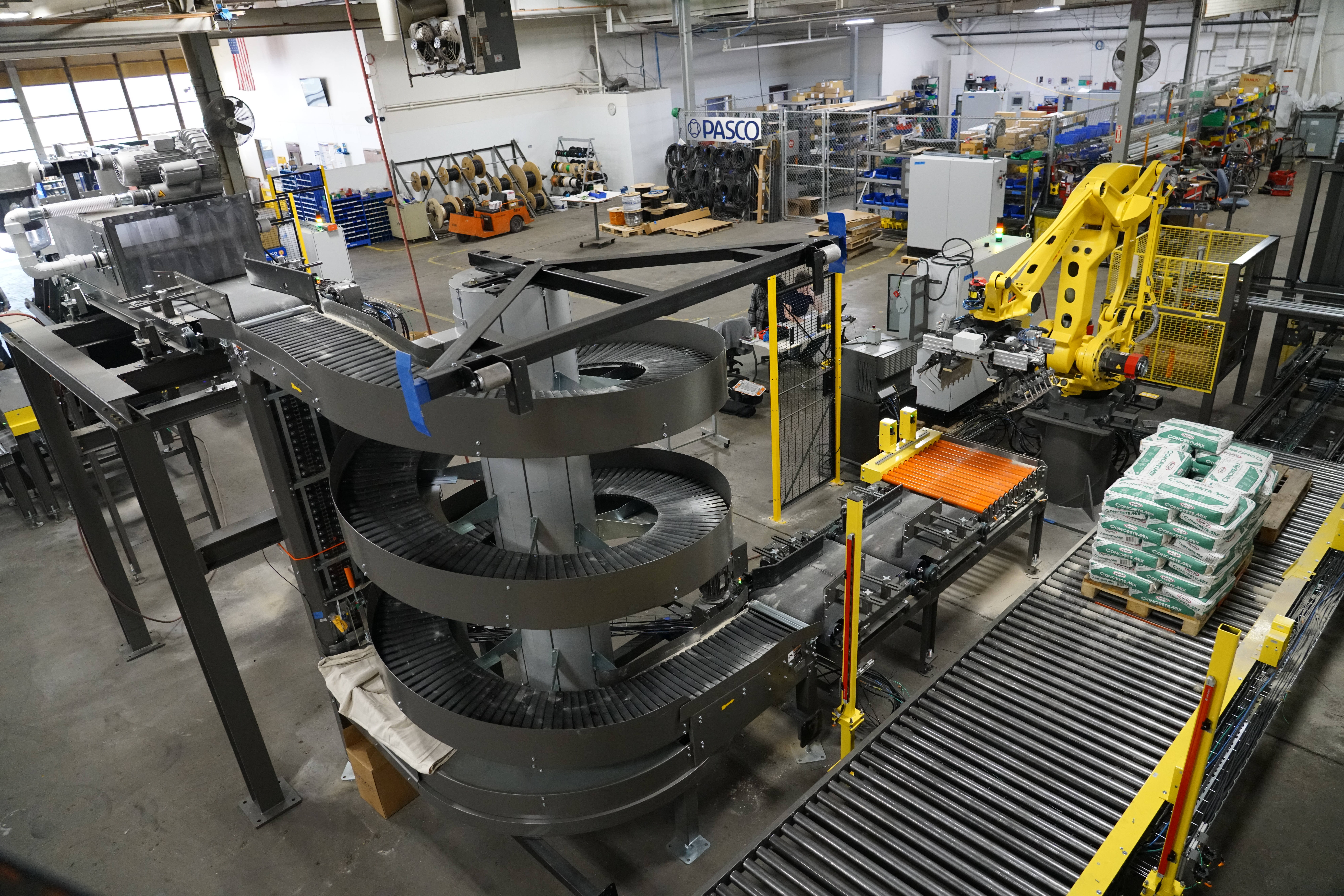
- Conveyors: Conveyors move product between every stage of the end-of-line process. They’re also the primary connection point between new automation and the equipment already running on the floor.
- Safety systems: Light curtains, emergency stops, guarding, and other safety features are built into end-of-line systems to protect workers operating near automated equipment. These aren’t add-ons but rather engineered into the system from the start.
- Controls and integration: PLCs, HMIs, and line controls tie the individual components together into a system that runs as one. Unified controls also allow the end-of-line to communicate with upstream equipment, keeping the whole line in sync.
Flexibility in robotic end-of-line systems
Robotic systems can be reprogrammed for new products, load configurations, or line speeds without tearing out and rebuilding the system. That matters in real production environments where SKUs change, throughput targets shift, and new products get added on short notice.
A well-designed robotic system handles multiple configurations on the same platform. Changeovers are often managed through the controller rather than physical tooling changes.

How to implement packaging line automation
Most successful automation projects follow the same basic pattern:
- Assess current processes: Get real numbers on throughput, bottlenecks, labor hours, damage rates, and injuries. The business case needs an honest baseline, and it needs to capture the full cost picture instead of just direct labor.
- Define the right scope: An automation project doesn’t have to be a full-line overhaul. One well-chosen automated function often unlocks more capacity than manufacturers expect, especially in mid-sized operations.
- Match equipment to the environment: Standard automation works in standard environments. Abrasive materials, corrosive chemicals, explosive atmospheres, and extreme temperatures all require systems engineered for those conditions from day one.
- Plan for integration: New equipment has to connect cleanly to what’s already on the floor such as conveyance, controls, line speeds and facility layout. Integration problems that surface during installation are more expensive than ones caught in the design phase.
- Train the team: Operators and maintenance staff need to know the system before it goes live. Training after commissioning costs more time and more line stops.
The automation integration process
A typical project moves through five stages:
- Needs assessment: Define production goals, throughput targets, product specs, environmental conditions, and facility constraints.
- Initial system design: Engineers build a layout that shows how the system fits the floor. This is the primary design artifact before any fabrication begins.
- Engineering & Manufacturing: Equipment gets built. When the team designing the system works in the same building as the people fabricating it, problems show up early when they’re still cheap to fix.
- Installation and commissioning: The system goes in and gets integrated with existing conveyance, controls, and upstream equipment.
- Performance confirmation: The system runs against documented throughput targets. If it doesn’t hit them, the project isn’t done.
Common challenges to plan for
Three challenges come up on most projects:
- Upfront cost: The initial investment is real. Evaluate it over a 15-20 year equipment lifecycle, not just the purchase price. Parts availability, service response, and vendor accountability have real dollar values over that window.
- Integration complexity: Connecting new automation to an existing line is harder than a standalone install. Controls, line speeds, and footprint constraints need to be solved in the design phase, not on the floor during installation.
- Change management: Workers who’ve run a manual line for years need time and real training to feel confident with an automated system. Build that into the project plan.

Understanding ROI and long-term value
Manufacturers typically see labor cost reductions of 40-50%, throughput gains of up to 50%, and product damage reductions of 20-30%. Payback runs 12-24 months depending on volume and shift structure.
Those numbers are a starting point, not the full picture. Injury costs, insurance premiums, warehouse rework, upstream idle time, and overtime rarely make it into the initial model but they account for 50-60% of the total benefit. A complete ROI analysis includes all of them.
Why palletizing is often the starting point
Palletizing is one of the most physically demanding jobs on the production floor with heavy lifting in harsh conditions, repeated across every shift. It also carries some of the highest injury rates in a facility. Automation removes workers from that risk and puts them in safer, higher-value roles.
It also produces more consistent loads. Stable, predictable stacking reduces damage claims and simplifies warehousing and transport. Systems built for extreme environments – cold storage, concrete dust, battery acid, explosive atmospheres – hold that consistency where standard equipment fails.

End-of-line automation solutions from PASCO®
PASCO® designs, manufactures, integrates, and supports end-of-line automation systems for manufacturers who can’t afford downtime. We’ve installed 1,200+ systems across 900+ facilities over 50 years, built for complex environments where standard equipment gives up.
Every system is engineered around what the customer actually runs, built in-house in St. Louis, and backed by a one-year zero-cost warranty and a throughput buyback guarantee. If the system doesn’t hit quoted throughput, we buy it back.
The same team that engineers and builds each system supports it for the life of the equipment – 1,200+ parts stocked for same-day shipping, and the ability to service systems decades after installation.
“It’s one manufacturing company talking to another. PASCO is one of us. We manufacture things, they manufacture things. We like that they understand us.”
– Dimitri Frangiadis, Capital Project Manager, Croda
View our equipment at pascosystems.com/equipment or request a quote.