End-of-line production is where throughput problems become visible. Labor shortages, inconsistent palletizing rates, and facility space constraints all converge at the same point in the line – and that’s where most manufacturers start thinking seriously about automation.
PASCO® has been engineering and building end-of-line automation since 1976. More than 1,200 systems are running across 900+ facilities worldwide. This overview covers how PASCO’s robotic palletizing and end-of-line automation solutions are engineered, what they accomplish on the floor, and what the process of working with PASCO as an OEM manufacturer looks like.
Technological advancements
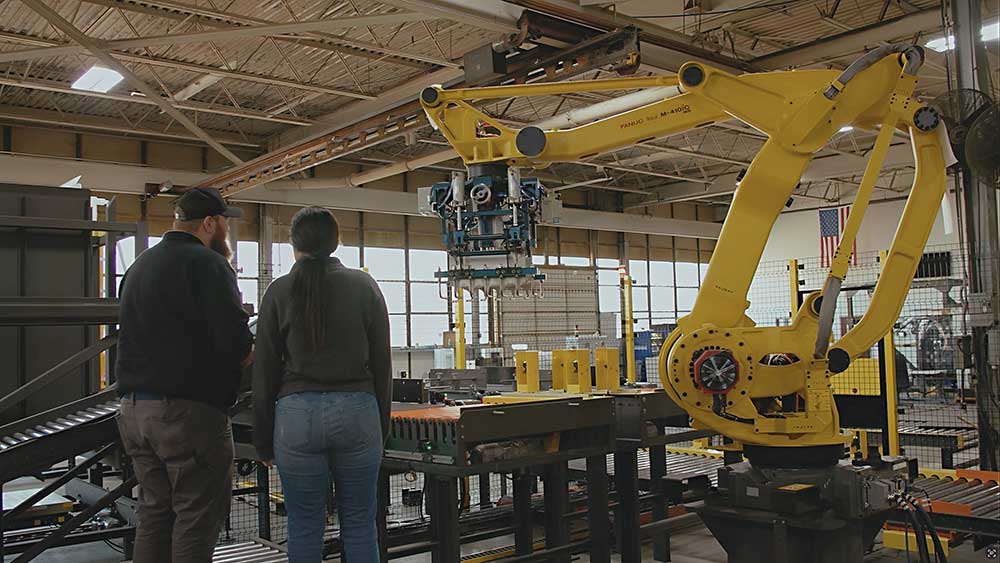
PASCO began integrating robotic systems into its end-of-line solutions in 2004. A properly configured robotic cell adapts to product changes in ways a fixed-frame conventional system can’t – handling multiple SKUs, adjusting to format changes, and reconfiguring layer patterns without mechanical retooling. That’s what drove the shift.
PASCO designs, programs, and manufactures critical components under one roof. When design and build happen in the same facility, problems surface before commissioning rather than after install. The engineers who lay out the system work alongside the machinists who fabricate the components. That feedback loop matters when the system has to run reliably for 15 to 20 years.

Manufacturing applications
What features define PASCO’s automated robotic palletizers?
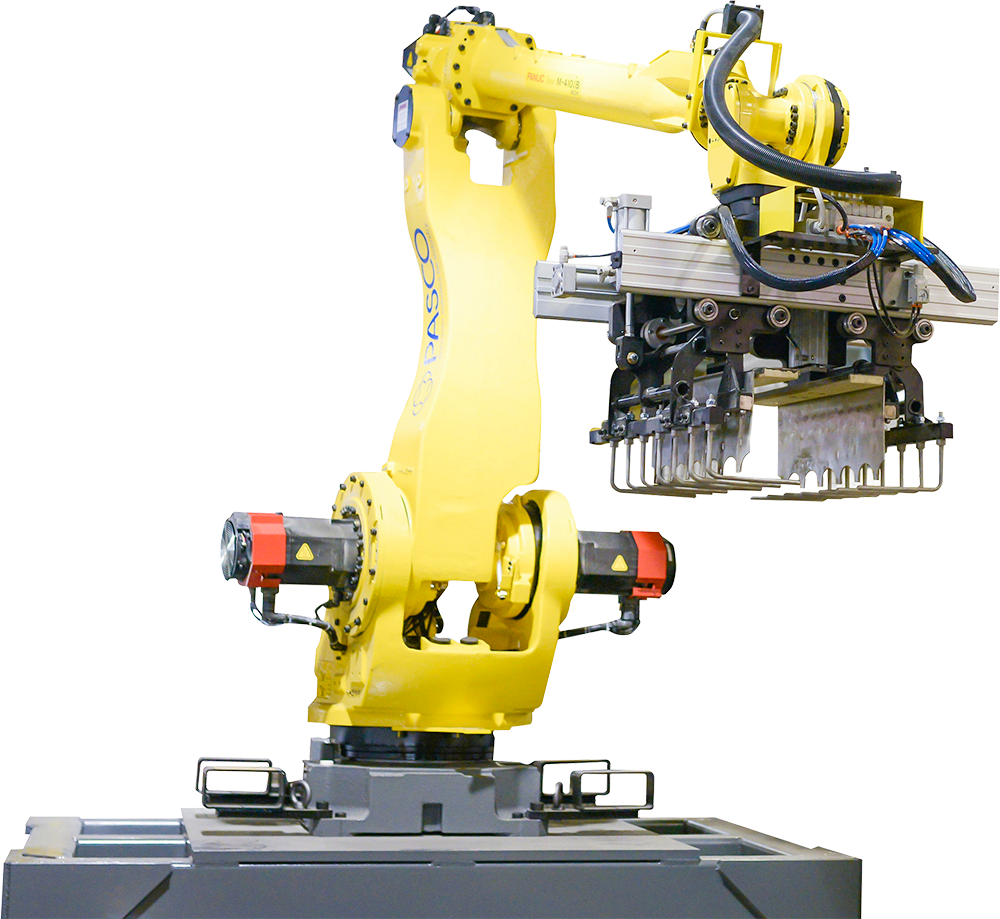
PASCO’s robotic palletizers are built around a centralized control architecture and end-of-arm tooling designed and manufactured in-house. PASCO’s EOATs routinely exceed 5 million cycles before overhaul – that’s measured performance from systems in the field, not a projected spec.
The systems are built for the environments where palletizing actually happens: hot, cold, damp, abrasive, and in some cases explosive-rated. Customizable tooling handles specific product dimensions, weights, and layer patterns your line requires. PASCO engineers and builds these systems in St. Louis, and the same team that designed the system handles support after install.
How do robotic palletizers reduce labor costs and increase line uptime?
Labor savings are real, but they’re often not the biggest part of the ROI picture. The more significant gains come from consistency and throughput. Manual palletizing introduces variation where consistency matters most – load stability, case orientation, layer count – and that variation compounds downstream. Robotic automation reduces manufacturing costs.
A robotic palletizer runs the same pattern at the same rate across every shift. When the end of the line runs at its designed rate, upstream equipment finally runs at its designed rate too. Companies that automate palletizing frequently report that upstream performance gains outpace direct labor savings over time. Reduced injury exposure – particularly repetitive stress and strain from manual stacking – is an additional outcome that doesn’t show up in initial ROI calculations but matters to the facilities that have experienced it.
What custom end-of-line automation solutions does PASCO provide for packaging lines?
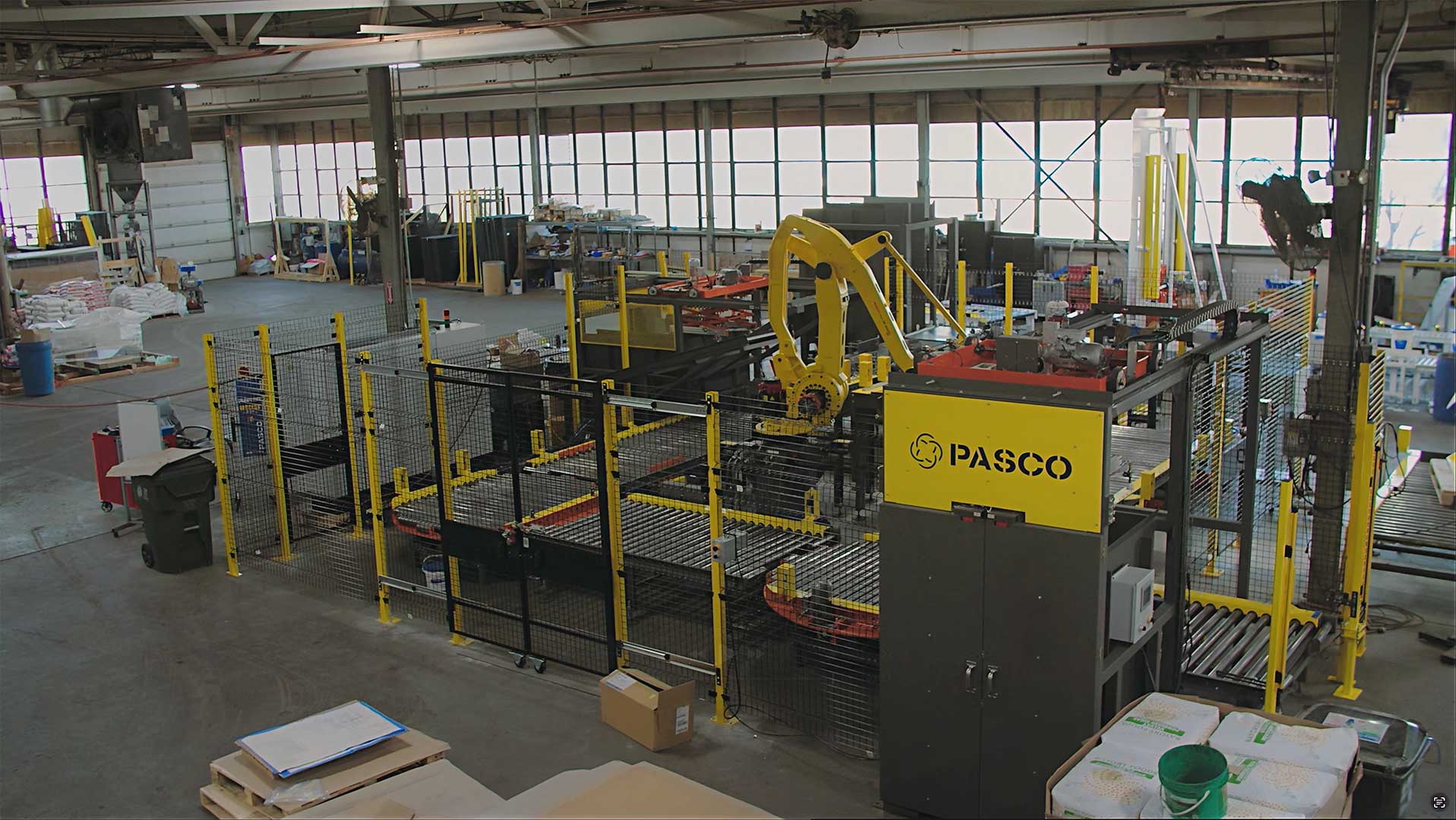
PASCO engineers end-of-line automation built around your specific production parameters: product dimensions, weight, throughput rate, floor footprint, and facility environment. That includes robotic palletizing systems, conventional palletizers, valve bag placing and filling and everything it takes to prep products for logistics.
The scope of the solution depends on where your line’s actual constraint is. Some installations require a full end-of-arm tooling redesign. Others need a single well-placed automation cell to unlock capacity that’s already there. PASCO’s engineers assess the production environment before specifying a system, not the other way around.
How does PASCO engineer tailored packaging automation systems?
The process starts with understanding what’s happening on your floor. PASCO’s engineers ask about production rates, product dimensions, load configurations, facility layout, and where the current line breaks down under pressure. That assessment drives the system design.
Because PASCO designs, programs, and builds in-house, engineering decisions don’t travel through a chain of subcontractors before reaching the shop floor. The team that specifies the system is the team that fabricates the components. This closes the gap between what was designed and what gets installed – and it means engineering changes can happen quickly when they need to.
Which material handling equipment complements PASCO’s custom automation?
End-of-line automation doesn’t run in isolation. Conveyors, depalletizers, stretch wrappers, and integrated control systems all have to work together for product to move through the line without disruption.
PASCO designs its systems to integrate with existing equipment where possible and to specify complementary equipment where gaps exist. Centralized control systems give operators visibility over the full end-of-line sequence – not just the palletizer. When something stops, the root cause should be identifiable quickly, not obscured by a patchwork of disconnected machines with separate interfaces.

Future trends
How does PASCO integrate sustainability into industrial packaging automation?
Sustainability decisions in packaging automation generally come down to material use, energy consumption, and throughput efficiency. Automated systems reduce damage rates, which cuts product loss and repackaging waste. Consistent load patterns reduce film use in stretch wrapping. Energy-efficient motor systems and smart control logic reduce power draw compared to older fixed-speed equipment.
PASCO engineers these outcomes into system design as part of specifying the right components for the application. When a system runs efficiently for 15 to 20 years, that longevity itself reduces the material and energy cost of replacement cycles.
What are the energy and waste reduction benefits of PASCO automation?
Automated palletizing systems reduce product damage rates – cases that aren’t crushed or improperly stacked don’t need to be reprocessed or scrapped. That’s direct waste reduction with a measurable cost impact.
On the energy side, variable frequency drives, efficient servo systems, and smart control logic reduce power consumption compared to older fixed-speed mechanical equipment. Facilities operating PASCO systems in continuous production environments have documented lower per-unit energy costs as a result. These are operational outcomes from systems in the field, not projected model estimates.
How do PASCO systems align with manufacturers’ carbon footprint reduction goals?
When manufacturers need to report on emissions or energy use at the facility level, end-of-line automation contributes in concrete ways: lower per-unit energy consumption, reduced waste from damaged product, and fewer manual handling steps that require additional equipment running in parallel.
PASCO’s systems are built to last 15 to 20 years, not to be replaced on a 5-year product cycle. Long-lived equipment carries a lower lifetime carbon cost than equipment requiring earlier replacement. That’s a function of how the systems are engineered and what parts availability looks like over the life of the machine.
Project inquiry and quote process
How can manufacturers request a detailed automation project quote?
Requesting a quote starts with a conversation about your production environment – throughput requirements, product dimensions, floor footprint, existing equipment, and where the current process is breaking down. PASCO doesn’t require a fully scoped project before that conversation. The initial discussion is diagnostic: understand what the line needs before specifying a system.
From there, PASCO’s engineers develop a proposal around what the application actually calls for. You work with the same team from the first call through commissioning – no handoffs to a sales layer disconnected from the people who build the system.
What support does PASCO provide throughout project consulting and implementation?
PASCO’s support model is built around direct access to people who know the system. The team that engineered and built it handles install, commissioning, and post-install support. PASCO’s technicians average 12+ years with the company – they know the equipment because they’ve been working on it.
After commissioning, PASCO provides operator training and maintains detailed engineering records for every system it builds. When a part needs to be replaced or a retrofit is needed 10 years post-install, those records still exist. Age doesn’t retire a system. Abandoned vendor relationships do.
What packaging automation investments are manufacturers prioritizing in 2026?
The investments with the clearest ROI case in 2026 cluster around three areas: throughput stability, labor dependency reduction, and long-term cost of ownership. Manufacturers that have delayed automation are facing labor markets where reliable palletizing headcount is harder to maintain, and where the cost of turnover in physically demanding roles is a line item that’s hard to ignore.
Adaptability is a priority too. Systems that handle multiple SKUs, product dimensions, and load configurations without a full retooling are getting attention from operations managing more product variety than they were five years ago. The ROI case doesn’t require projecting future growth. It starts with what the current production environment already costs.