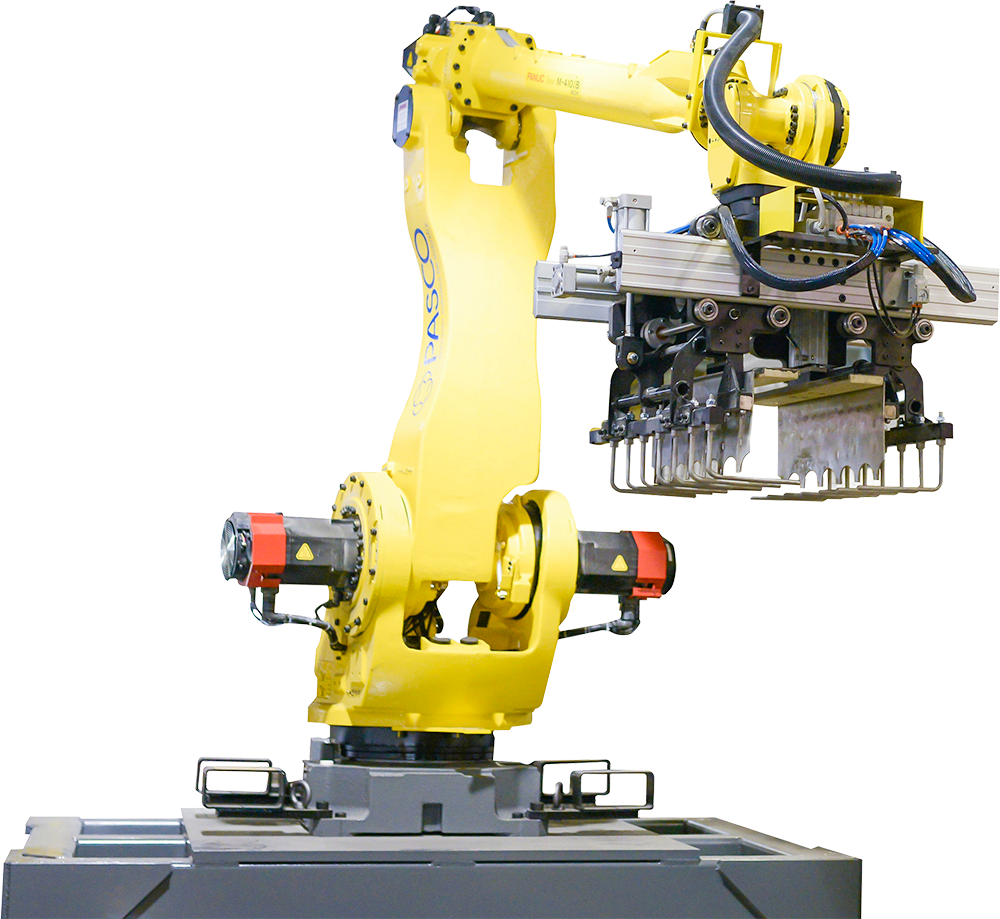

Historically, manufacturers had to choose between conventional palletizers for speed or robotic palletizers for flexibility. Today’s technology has narrowed this gap, giving you more options for your specific needs.
Explore our FAQ:
- What applications are best suited for conventional vs. robotic palletizers?
- How versatile are different palletizing systems for changing production needs?
- What are the speed differences between conventional and robotic palletizing systems?
- How do different palletizing systems impact overall production efficiency?
- What are the true cost differences between conventional and robotic palletizing systems?
- Which palletizing system requires less maintenance and downtime?
- What training is required for different palletizing systems?
- How do safety features compare between palletizing systems?
- How do I choose the right palletizing system for my manufacturing operation?
What applications are best suited for conventional vs. robotic palletizers?
Conventional palletizing systems excel with single SKUs at high rates, particularly for uniform products like drums and kegs where variety is limited. They’re optimal when standardized packaging moves through production consistently.
Robotic palletizing solutions handle both single and multiple SKUs, adapting easily to cases, bags, pails and virtually any product type. Their flexibility makes them valuable for facilities with diverse product lines or anticipated packaging changes.
How versatile are different palletizing systems for changing production needs?
Conventional palletizers offer limited versatility, requiring mechanical adjustments for product changes. These adjustments can slow production and impact efficiency, making them best suited for consistent production environments with minimal variation.
Robotic systems deliver higher versatility through adaptable end-of-arm tooling such as clamps, vacuum cups, and forks. Software-driven changeovers enable quick adaptation between product types, often accomplished in minutes rather than hours, allowing manufacturers with multiple product lines to minimize changeover downtime.
What are the speed differences between conventional and robotic palletizing systems?
Conventional palletizers maintain strength in high-volume, single-product applications with fixed speeds determined by mechanical design. Their consistent throughput for uniform containers makes them predictable performers in standardized environments.
Technology embedded in robotic systems has closed the gap, processing 50-lb bags at up to 27 bags per minute, with twin-robot configurations reaching 50 bags per minute. Unlike conventional systems, robots maintain this performance while handling various products and patterns, providing both speed and flexibility.
How do different palletizing systems impact overall production efficiency?
Conventional systems build individual pallets quickly but can be limited by their single-function operation and may create bottlenecks elsewhere in the line. Their efficiency is optimized when the entire production process is designed around their fixed capabilities.
Robotic palletizers can build multiple simultaneous pallet loads, adapt to production changes, and integrate more seamlessly with other processes. Their multi-purpose capabilities often improve overall system efficiency by adjusting to workflow variations rather than requiring workflows to adapt to the machine.
What are the true cost differences between conventional and robotic palletizing systems?
Initial investment for a conventional palletizer runs higher than a robotic system due to engineering complexity. Integrators can build conventional palletizing cells cheaply, but properly engineered systems do cost more upfront.
Conventional palletizers have higher operating costs due to multiple gear motors and complex moving parts that consume more energy and require significantly more maintenance. These systems typically run 15-25% higher in energy costs compared to robotic alternatives.
Robotic systems need less upstream conveyor, consume less energy, and reduce maintenance expenses. Five-year ownership costs typically run 15-20% lower than conventional systems. Their widespread operational savings often shorten the payback period for the initial investment.
Which palletizing system requires less maintenance and downtime?
Conventional systems have more moving parts leading to more frequent maintenance, though they require less specialized training for maintenance personnel. Their mechanical complexity necessitates more preventative maintenance interventions throughout the year.
Robotic palletizers achieve 99.7% verified uptime with significantly reduced maintenance hours (40-60% lower than conventional alternatives). Their exceptional reliability stems from fewer moving parts and advanced diagnostic capabilities that identify potential issues before they cause failures.
What training is required for different palletizing systems?
Conventional palletizers operate on familiar platforms with a lower learning curve for basic operation. Mechanical troubleshooting is similar to other plant equipment, making them accessible for maintenance teams with traditional manufacturing experience.
Modern robotic interfaces have become increasingly intuitive with pre-programmed recipes that simplify operation. While requiring initial specialized training, most manufacturers find that operators quickly adapt to the user-friendly touch screen interfaces.
How do safety features compare between palletizing systems?
Both conventional and robotic systems use similar safety features such as light curtains, perimeter fencing, and safety scanners with redundant mechanisms. The real comparison isn’t between automated systems, but how much safer both are compared to manual palletizing.
Manual palletizing involves repetitive lifting of 25-80 pound packages throughout shifts, leading to back injuries and worker compensation claims.
Automated systems eliminate these physical demands entirely, removing workers from the repetitive lifting that causes most end-of-line injuries.
How do I choose the right palletizing system for my manufacturing operation?
Choose conventional palletizing if:
- Your operation centers around heavy drum/keg handling with consistent, uniform products
- Product variety is unlikely to change and throughput demands are high
- Your facility has experienced maintenance personnel familiar with mechanical systems
Choose robotic palletizing if:
- You handle multiple products or anticipate future variety in your packaging needs
- You’re seeking higher reliability with lower maintenance requirements
- You need flexibility to adapt to changing production requirements
- Labor constraints or rising costs are driving automation decisions
The most successful implementations match the technology to your specific production environment, product mix and future growth plans.
Need help outfitting a palletizing system for your manufacturing facility?
Get in touch with our automation experts to discuss your specific palletizing needs and discover which solution will deliver the best ROI for your operation.