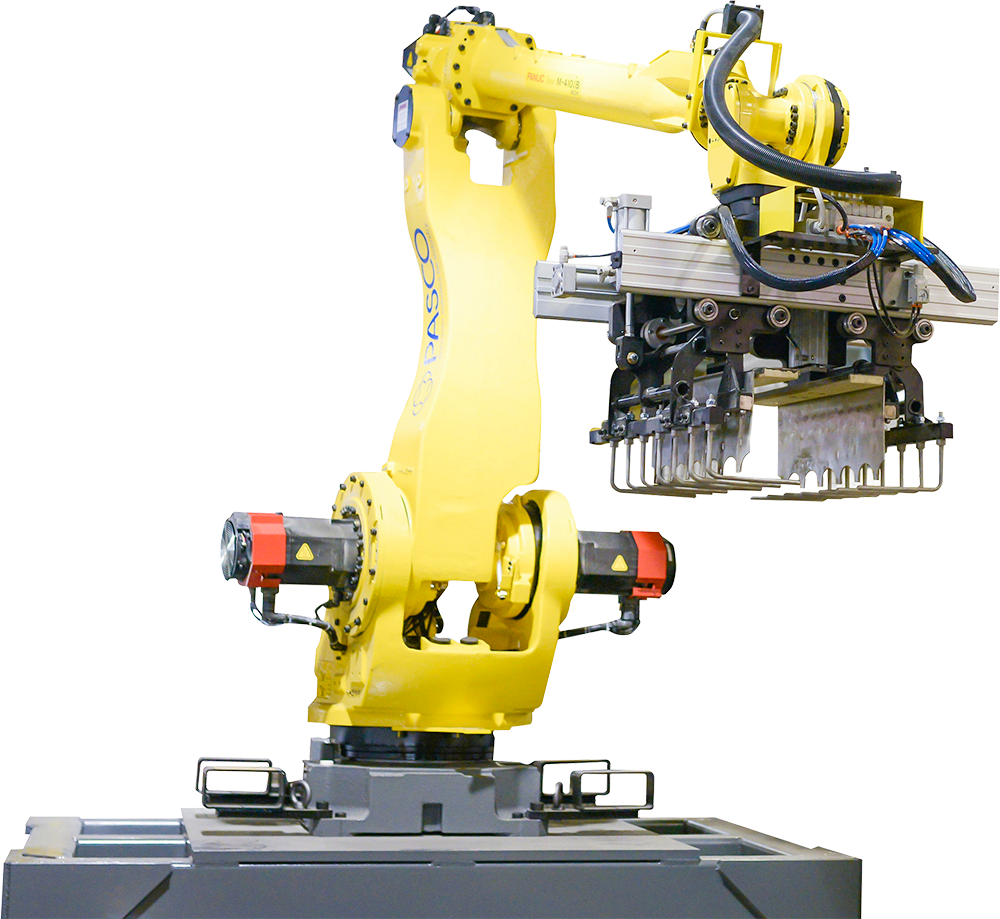
A manufacturer handling drums needed an end-of-line palletizing system that could support more than one drum size while fitting into an existing operation. The palletizing solution also needed to support a double stacked load configuration without adding unnecessary footprint or complexity.
What the system needed to do
The line produced multiple drum sizes and required a double stacked pallet pattern. The palletizing system also needed to place pallets and slip sheets and verify drum orientation prior to placement due to the way the tool grabs the drum and the need to avoid the latch on the drum rim.Meeting those requirements with conventional equipment would have required multiple pieces of standalone hardware, increasing footprint and integration complexity.
How the palletizing method was selected
We typically approach drum palletizing with conventional palletizers. In this case, the customer had a unique load requirement that called for double stacked loads. That requirement, combined with multiple drum sizes and orientation checks, made a robotic approach the more practical solution.At the required production rate, the robot had enough capacity to manage stacking, pallet placement, and slip sheet placement within a single cell. Designing around that capability allowed us to consolidate functions and keep the layout compact.
System design
The system uses a single robotic palletizing cell with a custom end-of-arm tool and integrated vision.
The cell:
recognizes drum orientation before picking
builds a double stacked pallet pattern
supports multiple drum sizes with quick changeover
places empty pallets
places slip sheets between layers
All tooling was designed and built in-house, which kept the system simple and predictable.
Throughput and flexibility
The required production rate allowed all functions to be handled without pushing cycle time limits.
The cell was engineered with additional margin so higher throughput can be supported later without redesign.
Integration into the existing line
The palletizer was designed to fit within the existing line layout and communicate with multiple systems on a new plant layout, receiving product and sending finished pallet loads. Keeping all palletizing functions in one cell reduced footprint and simplified integration.
What this system delivers
One cell handling multiple palletizing functions
Vision verification of drum orientation prior to picking
Consistent double stacked loads across drum sizes
Compact system footprint
Fewer components to maintain and support
Scalable design
Looking to automate drum palletizing?
If manual drum palletizing is slowing things down or creating safety issues, a well-designed automation system can simplify the end of the line without adding complexity. Let’s talk about what that could look like for your operation.
What are the common applications of industrial automation?
Common applications of industrial automation include packaging, palletizing, material handling, quality control, and assembly processes, helping manufacturers improve efficiency, consistency, and safety in their production workflows.
What are the benefits of automated palletizing systems?
Automated palletizing systems offer increased efficiency, accuracy, and consistency in packaging processes, enabling businesses to streamline operations, reduce labor costs, and enhance product quality.
How does automated equipment enhance product quality?
Automated equipment enhances product quality by ensuring consistent manufacturing processes, reducing human error, and enabling real-time quality control monitoring to identify and rectify issues promptly.
What is the initial investment for automated equipment?
The initial investment for automated equipment can vary depending on the complexity of the system, the features required, and the scale of the operation. Automated equipment can require significant upfront costs, but the long-term benefits of increased efficiency and reduced labor costs can often justify the investment.
How does industrial automation improve worker safety?
Industrial automation reduces worker exposure to hazardous tasks, minimizing safety risks and improving overall workplace safety by automating dangerous processes and reducing the need for human intervention.
What types of industries use automated equipment most?
Industries that rely heavily on automated equipment include manufacturing, packaging, warehousing, and logistics, where automated systems improve efficiency, productivity, and consistency in repetitive tasks.
What is the primary goal of industrial automation in manufacturing?
The primary goal of industrial automation in manufacturing is to improve efficiency, productivity, and consistency in the production process.
What are the benefits of using automated equipment in manufacturing?
The benefits of using automated equipment in manufacturing include increased efficiency, improved product quality, reduced labor costs, and enhanced safety in harsh industrial environments.
Can automated equipment be integrated with existing systems?
Yes, automated equipment can typically be integrated with existing systems. PASCO's automation solutions are designed for seamless integration, allowing clients to enhance their existing operations with advanced packaging and processing capabilities.
What is the role of robotics in industrial automation?
Robotics plays a crucial role in industrial automation by enhancing precision, speed, and efficiency in manufacturing processes, enabling businesses to optimize production, reduce errors, and increase overall productivity.
What types of products are commonly palletized?
Common products palletized are items such as packaged goods, boxes, crates, drums, and other bulk materials that can be stacked efficiently for storage and transportation.
How does industrial automation reduce production costs?
Industrial automation reduces production costs by improving efficiency, reducing labor expenses, and increasing output consistency and quality, leading to lower overall operational costs.
Can industrial automation replace human workers completely?
Industrial automation can enhance productivity and efficiency, but completely replacing human workers may not be feasible or desirable in many industries due to the need for specialized skills, flexibility, and human judgment.
pasco systems, pasco, pasco equipment, productive automated systems corporation, automation equipment, process automation solutions, pasco library hours, pasco flights, pasco to lax, paco systems, modular palletizing automation systems, modular palletizing systems, palletizing system integrator